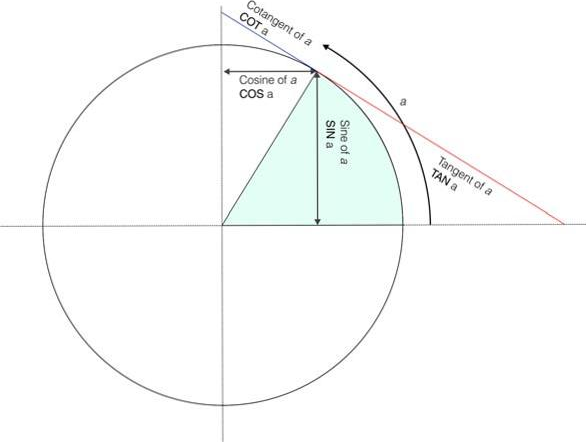
In the diagram of the point moving round the circle, look at the radius joining the centre to the point. You should be able to see that the distance we have called a, the distance
 Cotangent of a
COT a
Cosine of a
COS a
Sine of a
SIN a
a
Tangent of a
TAN a
Fig. 7 – Graphical representation of trigonometrical functions
that the point has moved round the edge of the circle, is a way of measuring the angle through which the radius has moved away from the x-axis.
When a=π/2, the angle is 90° (degrees).
When a=π, the angle is 180°; and so round to when a=2π, and the angle is 360°.
You might just as well forget about degrees, and measure the angle in terms of a alone: we say then that we are measuring the angle in radians. Thus π/2 radians=90° and so on.
You must always remember that in NextBASIC SIN, COS and so on use radians and not degrees. To convert degrees to radians, divide by 180 and multiply by π; to convert back from radians to degrees, you divide by π and multiply by 180.
Exercises
-
Using the knowledge you have gained from this chapter, define a function to convert radians to degrees (this may prove very useful to you in the future).
-
In Fig. 7 above, the function COT appears while it's not part of NextBASIC's vocabulary. Write a function that returns the value of the cotangent of a using TAN.
ZX Spectrum Next User Manual, 3rd Edition (ISBN 978-1-5272-5496-1), written and illustrated by Phoebus R. Dokos. Copyright © 2020-2024 Phoebus Dokos / SpecNext Ltd. Licensed under CC BY-NC-SA 4.0. This is a transcription and can contain errors; check any doubt against the printed page.