100   IF n=0 THEN PRINT z$:
      ENDPROC
120   IF n=1 THEN LET l=LEN z$
130   a$=z$(l)+z$+z$(l)
140   PRINT z$' INVERSE 1; a$
150 ENDPROC
160 STOP
As you can see, there's a default value for parameter n and two separate exit points for procedure HelloWorld: one at line 100 and one at line 150. Line 40 is mandatory or rather a condition to jump over the procedures defined is mandatory as without it, after execution of both procedures the next available line would have been 50. DEFPROC can only appear in a program line. Attempting to define a procedure interactively will result in the error Direct Command Error. Also, supplying the wrong type of variable as a parameter (ie. a string instead of a number) will result in the error: Q Parameter error.
Executing the program will return the following:
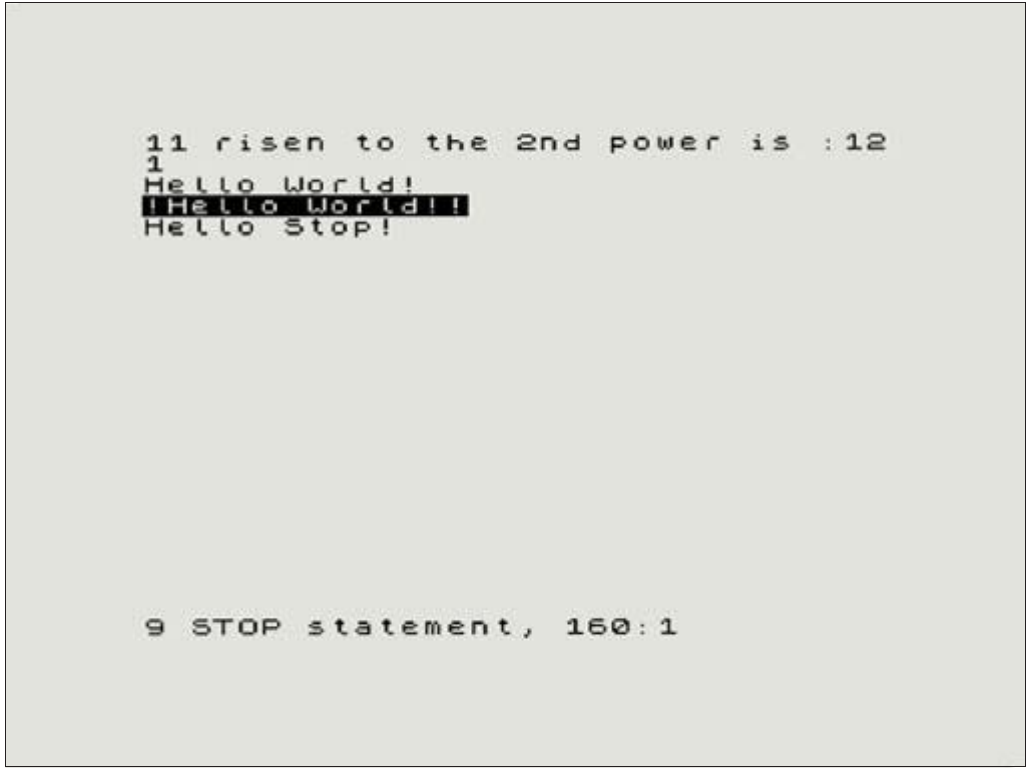
11 risen to the 2nd power is :12
1
Hello World!
!Hello World!!
Hello Stop!


9 STOP statement, 160:1
Fig. 3 - Screen output from the example procedures
As we saw in the definition of the DEFPROC, ENDPROC and PROC keywords as well as the examples above, there are optional parameters that can be passed to procedures when called with the results of the procedures' execution being assigned to multiple variables at the time. Consider this example that calculates the factorial of a number:
  10 INPUT "Enter a number
     1+:";x
  20 IF x>33 THEN PRINT "Your
     Next cannot handle this
     number!": GO TO 999
  30 PROC factorial(x) TO f
  40 IF f>0 THEN PRINT "The
     factorial of ";x;" is ";f:
     ELSE GO TO 999
 999 STOP
1000 DEFPROC factorial(n)
ZX Spectrum Next User Manual, 3rd Edition (ISBN 978-1-5272-5496-1), written and illustrated by Phoebus R. Dokos. Copyright © 2020-2024 Phoebus Dokos / SpecNext Ltd. Licensed under CC BY-NC-SA 4.0. This is a transcription and can contain errors; check any doubt against the printed page.