cause the CPU is given a new window in to a different bank in physical memory. This way the usable physical memory can far exceed the memory the CPU can normally see while, at the same time, older software is completely unaware and will continue to run properly without performing any bank switching.
Memory Management
There are two banking schemes employed in the ZX Spectrum Next: Standard and MMU-based banking. The Standard scheme is inherited from the +3 and the other 128K Spectrum models. The MMU scheme co-exists with the Standard scheme but it is unique to the ZX Spectrum Next.
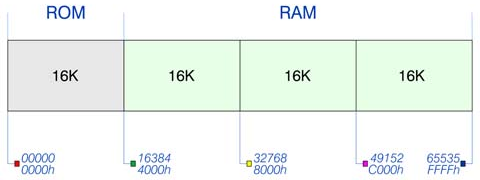
 ROM                              RAM
+----------------+----------------+----------------+----------------+
|      16K       |      16K       |      16K       |      16K       |
+----------------+----------------+----------------+----------------+
 00000            16384            32768            49152            65535
 0000h            4000h            8000h            C000h            FFFFh
Fig. 46 – Standard (NextBASIC) memory map
As you can see, in the memory map NextBASIC uses, the available 64K of addressable memory is divided into four slots of 16K each with the bottom slot always occupied by ROM. Standard banking, inherited from prior Spectrum models, selects which 16K ROM is visible in the bottom 16K slot (addresses 0 to 16383) and which 16K RAM bank is visible in the top 16K slot (addresses 49152 to 65535).
The Spectrum +3 introduced a new, so called, allRAM mode that could place a limited selection of arrangements of four 16K RAM banks into all four slots. This was not widely used and is often forgotten by programmers who mostly target the 128K Spectrum models prior to the +3. A good example of allRAM mode is running CP/M, that requires RAM at the bottom of the address map.
There is a total of four 16K ROMs to select from (inherited from the +3) and a total of 48 16K RAM banks available (112 in 2048K ZX Spectrum Nexts). If you make a quick calculation, that accounts for 832K in the unexpanded Issue 2 ZX Spectrum Next. The remaining portion of the 1024K is allocated to other uses, most notably to divMMC memory. The NextZXOS Startup menu reports available RAM only, which will be either 768K or 1792K.
The Standard banking scheme is controlled by hardware I/O ports (covered in the previous chapter) and via the BANK command and its variants which we will examine soon.
The MMU (memory management unit) scheme is diagrammed below. It is much more flexible in that it can map any 8K bank of physical RAM into any 8K slot of the CPU's addressable memory.
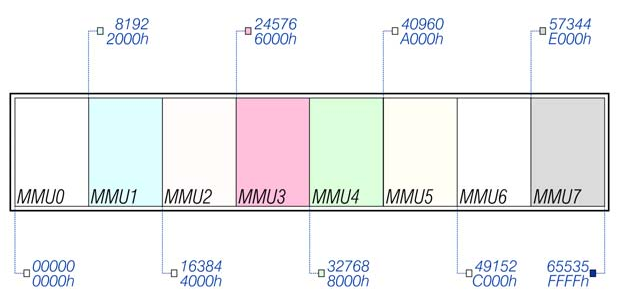
      8192             24576            40960            57344
      2000h            6000h            A000h            E000h
+--------+--------+--------+--------+--------+--------+--------+--------+
|  MMU0  |  MMU1  |  MMU2  |  MMU3  |  MMU4  |  MMU5  |  MMU6  |  MMU7  |
+--------+--------+--------+--------+--------+--------+--------+--------+
 00000            16384            32768            49152            65535
 0000h            4000h            8000h            C000h            FFFFh
Fig. 47 – MMU based memory map
ZX Spectrum Next User Manual, 3rd Edition (ISBN 978-1-5272-5496-1), written and illustrated by Phoebus R. Dokos. Copyright © 2020-2024 Phoebus Dokos / SpecNext Ltd. Licensed under CC BY-NC-SA 4.0. This is a transcription and can contain errors; check any doubt against the printed page.